
Before comparing a Joyagoo shipping estimate, record the destination, product types, packed weight, dimensions and selected service. This lets you explain why an estimate changes later. A number without its assumptions cannot tell you whether a new quote is better or simply describes another parcel.
A worked weight example
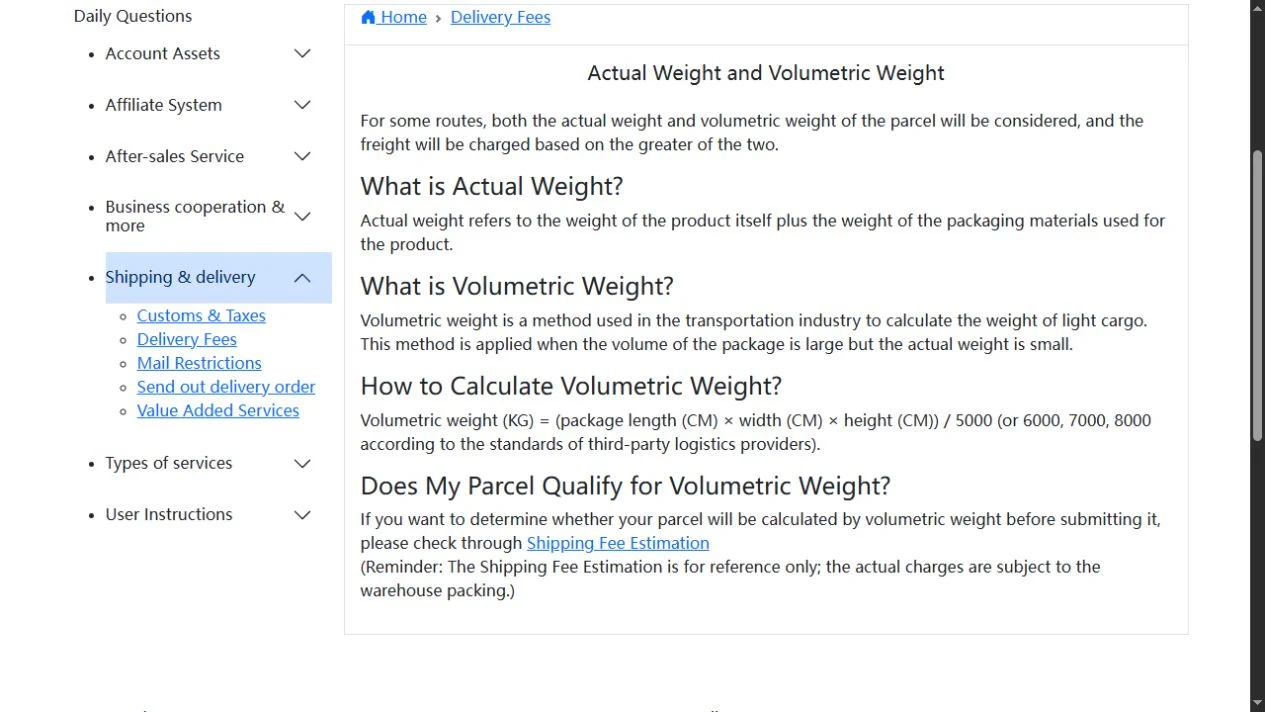
Imagine a parcel measuring 45 × 28 × 20 centimetres with an actual packed weight of 3 kilograms. Its volume is 25,200 cubic centimetres. With a hypothetical route divisor of 6,000, the volumetric result is 4.2 kilograms. A service using the greater of actual and volumetric weight would begin with 4.2 kilograms before applying its own rounding or other charging rules.
These are illustrative inputs, not a real customer's shipment or a freight quote. Joyagoo's help page lists 5,000, 6,000, 7,000 and 8,000 as possible divisors under different logistics standards. Use the rule of the selected service rather than treating one example as universal.
Test a packing change
If appropriate packing could reduce the example's height to 16 centimetres, the volume would become 20,160 cubic centimetres. At the same divisor, volumetric weight would be 3.36 kilograms. This shows the direction of the change, not the final price difference.
Necessary protection still matters. A structured bag or fragile bottle may need space that a folded T-shirt does not. Ask what can actually be changed before replacing the dimensions in your estimate.
Preserve a repeatable comparison
Keep the date and exact service alongside the result. If the contents, destination or packaging change, obtain a fresh estimate. Do not subtract guessed savings from an earlier total or assume the sum of bare product weights equals packed weight.
The shipping guide covers service and country questions. Warehouse planning helps when more items are still arriving. Before adding another piece, check the the catalog clothing category and decide whether it genuinely improves the purchase rather than merely filling space in an imagined parcel.